Quick answer
What are the five ways to grow revenue from existing customers?
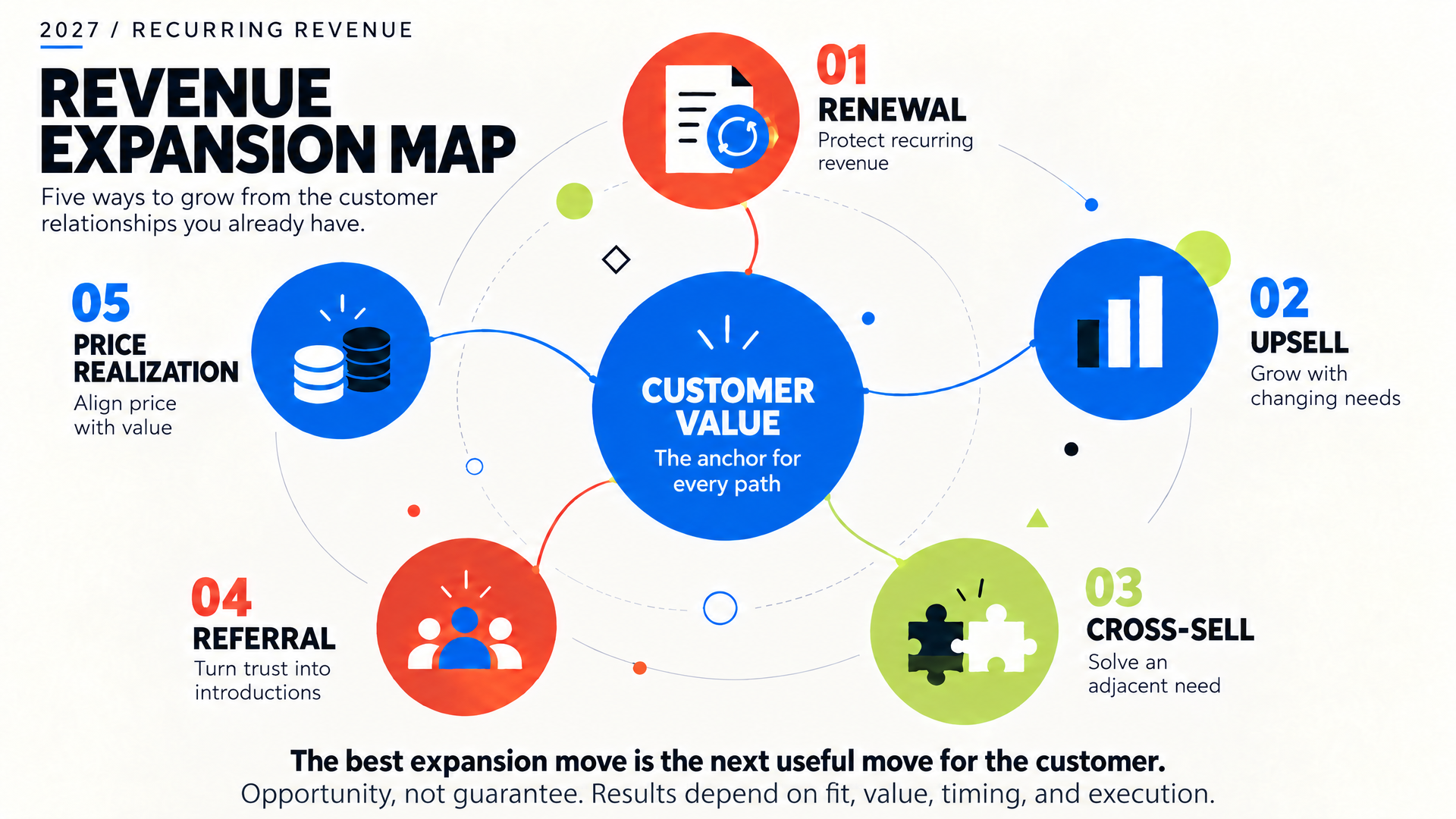
The five paths are renewal (protect recurring revenue), upsell (grow with changing needs), cross-sell (solve an adjacent need), referral (turn trust into introductions), and price realization (align price with value). All five are anchored in customer value: the best expansion move is the next useful move for the customer. Start with renewal, because expansion on a leaking base is wasted.
Price realization: Capturing the price your delivered value supports, through usage-based models, value-based tiers, and regular pricing reviews.
Gross revenue retention (GRR): The share of recurring revenue kept from existing customers after churn and downgrades, excluding expansion. It can’t exceed 100%.
Key idea 01
Your existing customers can grow revenue in five ways: renewal, upsell, cross-sell, referral, and price realization.
Key idea 02
Customer value is the anchor. The best expansion move is always the next useful move for the customer, not the next thing on your price list.
Key idea 03
Renewal comes first. Growth on a leaking base is wasted, so protect gross revenue retention before pushing expansion.
The map in three lines. Explore it below.
Your cheapest path to next year’s growth is usually inside your current customer base. Every existing customer can grow your revenue in five ways: they renew, they buy more, they buy something adjacent, they introduce you to peers, or they pay a price that better reflects the value they get. The Revenue Expansion Map puts those five paths around the one thing that makes every one of them work, which is customer value.
VALUEThe anchor for every path
01 Renewal
- Proactive engagement. Talk about outcomes well before the contract date, not just at renewal.
- Customer health scoring. Combine usage, support, and sentiment signals to flag risk early.
- Seamless processes. Make renewing easy, with clean paperwork, clear terms, and no surprises.
- Account planning. Agree on the outcomes each account needs in the next term.
Example targetGross revenue retention: 95%+
02 Upsell
- Feature adoption. Customers who use more of what they bought are ready for more.
- Usage monitoring. Watch for accounts nearing plan limits or starting new use cases.
- New product launches. Introduce new capabilities first to the accounts they fit best.
- Account planning. Tie growth triggers to each account’s goals.
Example targetARPU growth: +12% year over year
03 Cross-sell
- Tailored messaging. Position the next product around a problem the customer already told you about.
- Ecosystem integration. Show how your products work better together.
- Account planning. Map adjacent needs and the stakeholders who own them.
- Cross-functional synergy. Sales, customer success, and product work from one plan.
Example targetCross-sell ratio: +8% increase
04 Referral
- Incentive programs. Reward introductions in ways that suit B2B buyers.
- Customer advocacy. Build a group of champions who speak for you.
- Case studies and testimonials. Turn customer results into proof prospects trust.
- Account planning. Ask for introductions at moments of proven value.
Example targetReferral volume: +20% referred inbound
05 Price realization
- Usage-based models. Let price scale with the value customers actually get.
- Value-based tiers. Package features by the outcomes each segment pays for.
- Regular reviews and adjustments. Review price against delivered value at least once a year.
- Account planning. Pair any price change with the value story for that account.
Example targetMargin improvement: +5%
Hover over or tap any path to see how to work it.
Use it as a planning canvas for every key account. Start at the center with the outcome the customer needs next, then decide which path is the next useful move. Account planning runs through all five, because expansion that isn’t planned with the customer tends to feel like selling, and customers can tell.
The five paths in detail
01. How do you protect renewals?
Make renewal the natural result of value delivered all year. Engage on outcomes early, score account health continuously, and remove friction from the renewal itself. Expansion built on a leaking base is wasted, so renewal comes first.
- Proactive engagement. Talk about outcomes well before the contract date, not just at renewal.
- Customer health scoring. Combine usage, support, and sentiment signals to flag risk early.
- Seamless processes. Make renewing easy, with clean paperwork, clear terms, and no surprises.
- Account planning. Agree on the outcomes each account needs in the next term.
Metric to watch: Gross revenue retention. Example target: 95%+.
02. When is a customer ready for an upsell?
When their use of what they already bought is growing. Rising feature adoption, accounts approaching plan limits, and new use cases are the signals. Upsell follows the customer’s changing needs, not your quota.
- Feature adoption. Customers who use more of what they bought are ready for more.
- Usage monitoring. Watch for accounts nearing plan limits or starting new use cases.
- New product launches. Introduce new capabilities first to the accounts they fit best.
- Account planning. Tie growth triggers to each account’s goals.
Metric to watch: ARPU growth. Example target: +12% year over year.
03. How do you cross-sell without pushing?
Lead with a problem the customer already has, next to the one you solve today. Tailor the message to that need, show how the products work better together, and keep sales, customer success, and product on one account plan.
- Tailored messaging. Position the next product around a problem the customer already told you about.
- Ecosystem integration. Show how your products work better together.
- Account planning. Map adjacent needs and the stakeholders who own them.
- Cross-functional synergy. Sales, customer success, and product work from one plan.
Metric to watch: Cross-sell ratio. Example target: +8% increase.
04. How do you turn customers into referrals?
Ask at moments of proven value and make advocacy easy. Pair a simple incentive program with a champion community and published case studies, so satisfied customers have both a reason and the material to introduce you.
- Incentive programs. Reward introductions in ways that suit B2B buyers.
- Customer advocacy. Build a group of champions who speak for you.
- Case studies and testimonials. Turn customer results into proof prospects trust.
- Account planning. Ask for introductions at moments of proven value.
Metric to watch: Referral volume. Example target: +20% referred inbound.
05. What is price realization?
Price realization is capturing the price your value supports. It means aligning pricing with delivered value through usage-based models, value-based tiers, and regular reviews, rather than discounting by default or leaving price untouched for years.
- Usage-based models. Let price scale with the value customers actually get.
- Value-based tiers. Package features by the outcomes each segment pays for.
- Regular reviews and adjustments. Review price against delivered value at least once a year.
- Account planning. Pair any price change with the value story for that account.
Metric to watch: Margin improvement. Example target: +5%.
Where should you start?
Start with renewal, then move outward one path at a time. A strong retention base makes every other path cheaper and more credible.
- Anchor on customer valueFor each key account, write down the outcome the customer is trying to achieve in the next 12 months.
- Protect the baseScore account health and fix renewal risk before pursuing growth in that account.
- Pick the next useful moveChoose one path per account based on the signals: usage growth points to upsell, an adjacent problem to cross-sell, a strong result to referral, and a value gap to price realization.
- Track one metric per pathGross revenue retention, ARPU growth, cross-sell ratio, referral volume, and margin. Set targets from your own baseline.
- Review quarterlyRevisit each account plan every quarter and move to the next path when the current one is working.
About the example targets
The targets on the map are illustrative starting points for planning, not industry benchmarks. Set yours from your own baseline, your segment, and your contract terms.
Download the one-page Revenue Expansion Map (PNG) to use in account planning sessions.
Frequently asked questions
What is expansion revenue?
Expansion revenue is additional recurring revenue from existing customers, through upsells, cross-sells, and price increases. Together with renewals and referrals, it’s usually the lowest-cost source of growth in a B2B or subscription business, because the trust and the relationship already exist.
What is the difference between upsell and cross-sell?
An upsell sells more of what the customer already buys, such as a higher tier, more seats, or more usage. A cross-sell sells a different product that solves an adjacent need.
What is the difference between gross and net revenue retention?
Gross revenue retention measures how much recurring revenue you keep from existing customers after churn and downgrades, excluding expansion, so it can’t exceed 100%. Net revenue retention adds expansion from upsells, cross-sells, and price increases, so it can exceed 100%.
Which expansion path should a company focus on first?
Renewal. Expansion on top of high churn is wasted effort. Once retention is healthy, choose the next path account by account based on the signals each customer is showing.
How does account planning support expansion revenue?
Account planning ties every expansion move to the outcome the customer needs next. It identifies growth triggers, adjacent needs, referral moments, and pricing conversations in advance, so expansion feels like help rather than selling.
Example targets on this map are illustrative planning starting points, not industry benchmarks.